Have you ever wondered why fish muscles are drastically sensitive to heat and light exposure? Well, those are made up of relatively short bundles than the long muscle fibers in meat. In addition, compared to the meat of other animals, fish muscle has a relatively tiny amount of connective tissue, which is arranged in thin sheets perpendicular to the muscle bundles.
What does all of this imply? To put it another way, fish cannot bear the heat coming directly from the sun or any other artificial source, therefore, knowing their finished cook temperature is very important. For a handful of our favorite portions, we will find out what are the most suitable temperatures to cook the seafood and make it up to the mark.
Seafood and Its Internal Temperature
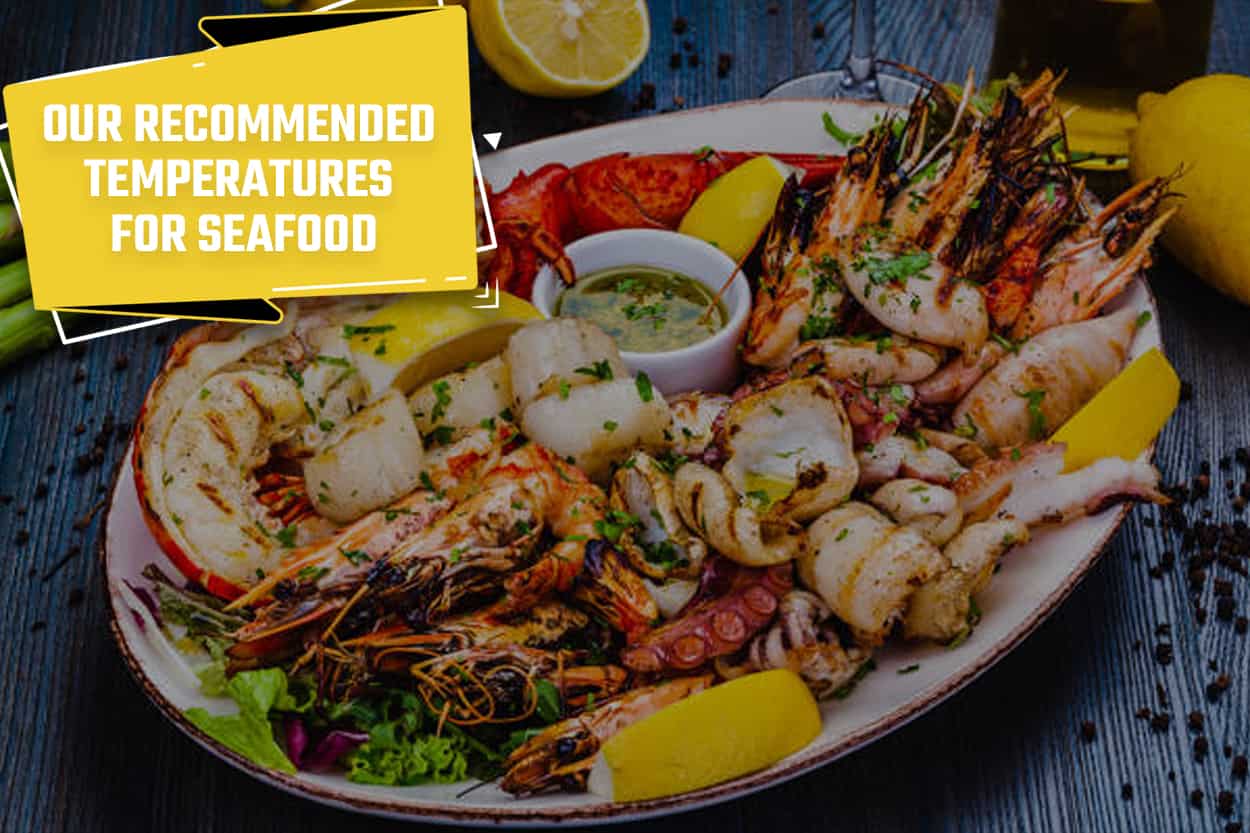
While cooking for the beloved ones, it should always remain the priority to serve them with the food that is cooked at the most appropriate temperatures without getting burnt or left undercooked. Keeping an eye on the temperature should be done thoroughly. There is a range of multiple temperatures that are considered for cooking a wide range of seafood including fish, shrimps, crabs, etc. Let’s figure out what are that specific seafood and the required temperatures to get them well done before serving them on your dinner table. https://www.chefstemp.com/wp-content/uploads/2022/02/Seafood.jpg|
Items |
Temperature |
Description |
|---|---|---|
| 1.Fish with fins | 145°F (63°C) | Cook well until the meat is translucent and readily separated with a finger |
| 2.Salmon | 125°F (52°C) | Since salmon does not contain enough quantities of protein and therefore it is more likely to release water if not cooked on the desired temperature. The most suitable temperature is 125°F or 52°C for salmon which ensures the fish is cooked well both inside out. |
| 3.Lobster | 140°F (60°C) | Lobsters are a bit challenging to cook and it can go too wrong to handle due to the lack of greasy fats that make the meat more flavorful and juicy. Lobsters should be cooked to perfection since they are quite a luxurious cuisine and need chefs’ precious time to get cooked definitely. If you cook it too long, it will become stiff, dry, and unappealing, and if you cook it too short, it will have an unusual texture and underdeveloped taste. Lobsters should be cooked to an internal temperature of 140°F, regardless of how it is prepared. Keep an eye on the temperature while grilling lobster, boiling or steaming it. |
| 4.Shrimp | 120°F (49°C) | Shrimps are very swift and can be destroyed before landing on the plates if not cooked or fried at the appropriate temperatures. Take the thermometer probe and insert to check whether the temp is below or equal to 120°F. Identify if the color changes from pink to pale pink or slightly towards brown, it means your shrimps are almost ready. |
| 5.Scallops | 130°F (55°C) | Containing little quantities of protein, scallops are moist and are normally cooked on high heat. They are recommended to be cooked under or exactly at 130°F until the outer parts become roasted brown. This way the taste and the color both remain balanced. |
| 6.Halibut | 130°F (55°C) | Halibut is quite a sturdy fish that keeps its shape intact when cooked. It’s done when the internal temperature hits 130°F to 135°F. It’s ideal for grilling because of this. It is frequently overdone and dry, although the middle should only be beginning to get opaque. |
| 7.Tuna | 115°F (46°C) | The more flavorful cuisine Tune is, the more critical it is to handle while cooking. Generally, people have tuna in rare form as it loses all the flavors when overcooked. So 115°F or below will be the appropriate temperature for it. |